
Chimney Sweep
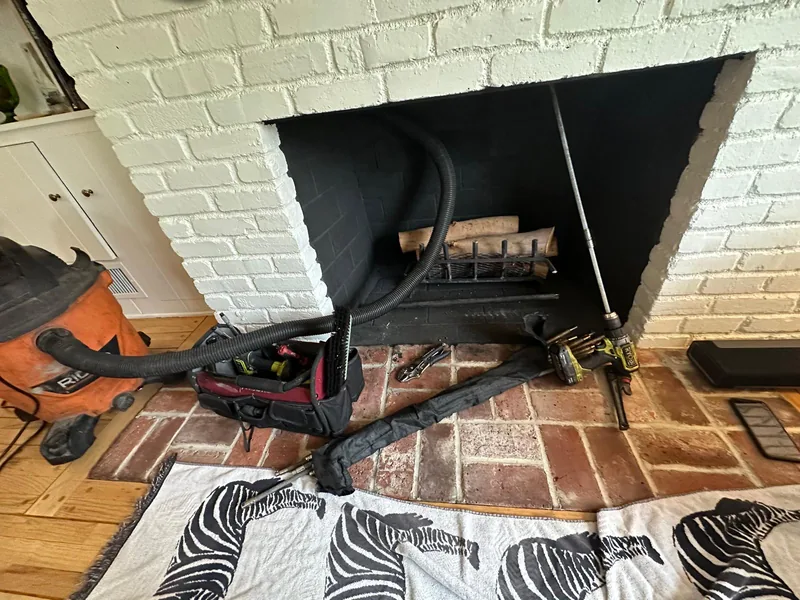
A full soot and creosote removal from the firebox through the smoke chamber, flue and cap — with drop cloths down and a HEPA vacuum running the whole time.
Learn more about Chimney SweepSmoke rolling into the room is rarely just a dirty chimney. Here are the eight real causes, in the order we check them, and which ones you can fix yourself.
Before anyone quotes you for work, run through the things that cost nothing. A surprising share of smoking complaints resolve at this stage, and any honest sweep would rather you tried these first.
Not partly. Reach up and confirm by feel that the plate has swung clear, because a damper that moves a few inches and stops feels open from the handle.
A cold flue holds a plug of dense cold air that resists the first smoke. Roll a newspaper, light it, and hold it up at the damper for a minute to warm the flue before lighting the fire.
Crack a window in the same room. If the smoking stops immediately, you have a house pressure problem rather than a chimney problem.
Kitchen range hoods, bathroom fans and clothes dryers all pull air out of the house. Any of them can beat a fireplace for draw.
Wet wood produces cool, heavy, wet smoke that will not rise properly. Properly seasoned wood is a genuine fix, not a platitude.
If cracking a window stops the smoking, stop reading about chimneys. Your problem is negative pressure in the house, and that is a different fix entirely.
Modern homes are built tight, and tight homes are a problem for open fireplaces. A fireplace needs a substantial volume of replacement air flowing up the flue, and it has to come from somewhere. In a well-sealed house, there is no easy path for it.
Worse, other appliances compete for the same air. A powerful kitchen range hood can move several hundred cubic feet per minute out of the building. When it wins, the path of least resistance for makeup air becomes your chimney, and air flows down the flue instead of up — bringing smoke with it.
Homes in the newer Elk Grove, Roseville and Folsom developments are particularly prone to this, simply because they are built to much tighter envelope standards than a 1950s Carmichael ranch. The classic signature is a fireplace that behaves perfectly on some evenings and smokes badly on others, correlating with whether the range hood is running.
Once house pressure is ruled out, the chimney itself comes into question. These are the causes we check, in the order we check them.
The smoke chamber one is worth expanding on, because it is invisible and it is common in the older Arden Park and Wilhaggin homes we service. The smoke chamber is the tapered transition above the damper that funnels smoke into the flue. When it was built by corbelling stepped bricks inward and was never parged smooth, every step creates turbulence that disrupts the draft permanently. No amount of sweeping fixes it. Parging it smooth with refractory mortar usually does, and it often solves a problem a family has lived with for decades.
Two dimensional rules explain a large share of chronic smoking fireplaces, and both are worth knowing because they tell you whether you have a maintenance problem or a design problem.
The first concerns flue sizing. For an open masonry fireplace, the flue's cross-sectional area should be roughly one tenth of the fireplace opening's area. If a previous owner enlarged the firebox opening without touching the flue, or the original mason simply got it wrong, the flue cannot move the volume the opening demands. A smoke guard that reduces the opening height is often the practical fix.
The second concerns height. The chimney must extend at least three feet above the point where it penetrates the roof, and at least two feet higher than anything within ten feet of it horizontally. Chimneys that fail this — usually because a tree has grown or an addition was built — sit in a turbulent pressure zone where wind can push down the flue.
If your fireplace has smoked since the day you moved in, suspect a design problem. If it started recently, suspect a blockage, a change in the house, or a tree that has grown.
Questions
That is almost always a cold flue, and it is the most benign version of this problem. The column of cold, dense air sitting in the chimney has to be displaced before an updraft establishes. Prime the flue by holding a rolled, lit newspaper up near the damper for a minute or two before lighting the fire — you will often feel the draft reverse.
Rarely, but yes. An excessively tall flue lets the gases cool too much on the way up, which weakens the draft and increases creosote deposition. It is far less common than a chimney being too short, and it is not something to worry about unless a specific reason suggests it.
It might, if the cause is height or wind. It will not, if the cause is negative pressure in the house, a blocked flue, or a rough smoke chamber. This is exactly why we diagnose before quoting — selling you a taller flue for a house pressure problem is both expensive and useless.
Related
A full soot and creosote removal from the firebox through the smoke chamber, flue and cap — with drop cloths down and a HEPA vacuum running the whole time.
Learn more about Chimney SweepMore
William Chimney Sweep LLC
6130A Fair Oaks Blvd
Carmichael, CA 95608
(916) 269-0725
info@williamchimneysweepllc.com
| Monday | Open 24 hours |
|---|---|
| Tuesday | Open 24 hours |
| Wednesday | Open 24 hours |
| Thursday | Open 24 hours |
| Friday | Open 24 hours |
| Saturday | Open 24 hours |
| Sunday | Open 24 hours |
Fast response. No obligation.