
Chimney Sweep
A full soot and creosote removal from the firebox through the smoke chamber, flue and cap — with drop cloths down and a HEPA vacuum running the whole time.
Learn more about Chimney SweepThe honest answer is not once a year for everyone. Here is how burn volume, wood moisture and appliance type actually set your sweeping interval.
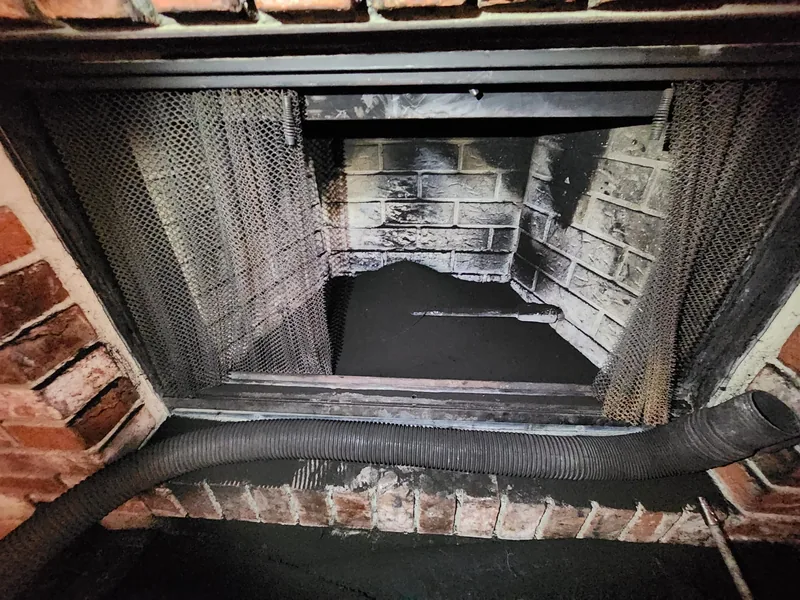
Almost every article on this subject opens by telling you to sweep your chimney once a year. That advice comes from NFPA 211, the National Fire Protection Association standard for chimneys and venting, and it is worth reading what the standard actually requires, because it is not quite what people repeat.
NFPA 211 calls for chimneys to be inspected at least once a year, and to be cleaned as needed based on what that inspection finds. Those are two separate things. The inspection is annual and non-negotiable, because caps rust, crowns crack and animals nest whether you light a fire or not. The sweeping is conditional.
Inspection is annual for every chimney. Sweeping happens when the inspection says it should — which for most regular burners does work out to once a year, but not for everyone.
This distinction matters because it cuts both ways. A household burning four cords through an airtight stove may genuinely need cleaning twice in one winter. A weekend-only fireplace user may safely go two seasons between sweeps. Applying a single interval to both is how one household wastes money and the other has a flue fire.
Four variables do most of the work in determining how quickly your flue loads up.
The strongest predictor by far. Roughly a cord of wood a year is the traditional threshold for an annual sweep. Three or more cords, and a mid-season check becomes worthwhile.
Unseasoned wood carries water that absorbs heat and cools flue gases. Cooler gases condense more creosote. Green wood can double your deposition rate compared to properly seasoned wood.
Long, damped-down overnight burns deposit far more creosote than shorter hot fires. Efficiency and creosote are in direct tension: the more heat you keep in the room, the cooler the flue runs.
An open masonry fireplace runs a hot, fast, inefficient flue that self-cleans to a degree. A modern airtight stove runs cool and tight, and loads its connector pipe quickly.
This is why we give different answers to customers in Orangevale, where daily wood heat through a stove is common, than to customers in a Gold River home with a gas log set that has never produced a particle of creosote.
Creosote is graded in three degrees, and the difference between them is not academic — it determines whether a sweep is a routine visit or a serious removal job.
Third-degree glazed creosote is the one that causes chimney fires. It ignites around 451°F, and once it is burning it can reach over 2,000°F inside a flue rated for far less. That is hot enough to crack clay tile liners and, in a bad case, to reach the framing behind the wall.
It also cannot simply be brushed out. Glazed creosote needs chemical treatment to make it brittle, followed by mechanical removal, sometimes over more than one visit. Letting a system get to that point turns an inexpensive annual service into a significant job.
Our local climate pushes people toward exactly the burning habits that produce creosote fastest. Sacramento winters are mild and damp rather than genuinely cold, so most households are not running a stove flat out for heat — they are burning low, slow and long for atmosphere on a chilly evening. That low, cool burn is the worst case for deposition.
Based on what we actually find in flues across Carmichael, Fair Oaks, Citrus Heights and the surrounding area, this is the guidance we give:
If you cannot remember the last time anyone looked at your chimney, the interval question is already answered. Start with an inspection and set the schedule from what it finds.
Questions
Partly. Shine a bright light up past the damper and look at the flue walls. If you can scratch a deposit and it comes off as dry flakes roughly an eighth of an inch thick or more, it is time. What you cannot assess from the firebox is the smoke chamber, the upper flue, or the condition of the liner joints — and those are where the problems that matter tend to be.
Not as a replacement. They contain a catalyst that can make some creosote more brittle, which helps slightly at the margins. They remove nothing from the flue, they cannot touch the smoke shelf where the heaviest debris collects, and they cannot inspect anything. Treat them as a mild supplement between real sweeps, never instead of one.
No, and mid-season is often exactly the right time for a heavy burner. We work year round and take emergency calls at any hour. The only reason we suggest booking in summer is that November and December are when everyone else calls, so waits are longest and any repair we find has to be done in the rain.
Related
A full soot and creosote removal from the firebox through the smoke chamber, flue and cap — with drop cloths down and a HEPA vacuum running the whole time.
Learn more about Chimney SweepMore
William Chimney Sweep LLC
6130A Fair Oaks Blvd
Carmichael, CA 95608
(916) 269-0725
info@williamchimneysweepllc.com
| Monday | Open 24 hours |
|---|---|
| Tuesday | Open 24 hours |
| Wednesday | Open 24 hours |
| Thursday | Open 24 hours |
| Friday | Open 24 hours |
| Saturday | Open 24 hours |
| Sunday | Open 24 hours |
Fast response. No obligation.